 freeman4u16
Every year, thousands of talented Nigerian graduates dream of continuing their education in the United Kingdom but are held back by one thing: cost. Tuition fees for international students in the UK can run into tens of thousands of pounds, before you even factor in flights, accommodation, and living expenses. The Commonwealth Scholarship exists precisely to close that gap. It is one of the oldest, most respected, and most generous fully funded scholarship programmes open to Nigerians, and unlike many “scholarships” you see advertised online, it is completely free to apply for and covers virtually every cost of studying in the UK.
If you are a Nigerian graduate considering postgraduate study abroad, this guide walks you through what the Commonwealth Scholarship actually is, who runs it, who qualifies, what it pays for, and exactly how to apply through Nigeria’s official nomination channels.
What Is the Commonwealth Scholarship?
The Commonwealth Scholarship and Fellowship Plan (CSFP) is a UK government-funded initiative, administered by the Commonwealth Scholarship Commission (CSC) and funded through the UK’s Foreign, Commonwealth & Development Office (FCDO). It was created to support talented, promising individuals from Commonwealth countries who might not otherwise be able to afford postgraduate study in the UK, on the understanding that they will return home and use their new skills to contribute to national development.
Nigeria, as a Commonwealth member nation, is one of the eligible countries, and Nigerian applicants have consistently been among the largest groups of recipients on the programme. The scholarship is not tied to any single university; instead, successful applicants can study at any UK institution that accepts them, provided the course fits within the Commission’s development priority areas.
Types of Commonwealth Scholarships Open to Nigerians
The Commonwealth umbrella actually covers several distinct award categories. Knowing which one fits your situation matters, because each has slightly different rules and application routes.
1. Commonwealth Master’s Scholarships
For Nigerian graduates who want to pursue a full-time taught master’s degree at a UK university. This is the most commonly applied-for category and is nominated through Nigeria’s Federal Scholarship Board.
2. Commonwealth PhD Scholarships
For candidates pursuing a full-time doctoral degree in the UK, particularly in fields tied to development priorities such as health systems, science and technology, governance, and climate resilience.
3. Commonwealth Shared Scholarships
These are jointly funded by the Commission and participating UK universities, targeted at development-related master’s courses. Shared Scholarships can be applied for directly through the participating university rather than only through a national nominating body, which gives Nigerian applicants an alternative route.
4. Commonwealth Distance Learning Scholarships
Designed for applicants who cannot leave their jobs or home country for full-time study. These allow you to study a UK master’s degree remotely while remaining in Nigeria, and are especially useful for working professionals.
5. Queen Elizabeth Commonwealth Scholarships (QECS)
Run separately by the Association of Commonwealth Universities rather than the CSC, QECS funds two-year master’s degrees at partner universities across low- and middle-income Commonwealth countries, with an emphasis on cultural exchange and community impact. QECS typically runs two application cycles a year, so it’s worth checking even outside the main CSC application window.
Who Is Eligible?
Eligibility requirements are set by the Commonwealth Scholarship Commission, though the Federal Scholarship Board applies its own screening on top. Broadly, to qualify as a Nigerian applicant you need to:
- Be a Nigerian citizen and be permanently resident in Nigeria at the time of application (the scholarship is not for Nigerians who have already relocated abroad).
- Hold, or be about to hold, an undergraduate degree of at least Second Class Upper Division (2:1) for Master’s Scholarships.
- Hold a relevant postgraduate degree for PhD applications; a Second Class Lower Division first degree is generally accepted for PhD candidates.
- Have completed or be exempted from the National Youth Service Corps (NYSC), and be able to provide your discharge or exemption certificate.
- Be unable to afford to study in the UK without financial support — this is a genuine part of the assessment, not a formality.
- Be available to begin your studies in the UK by the start of the relevant academic year, typically September/October.
- Meet the English language requirements of your chosen UK university.
- For Master’s applicants, most nominating processes require that you already hold at least two provisional or unconditional offers of admission from UK universities before you are nominated.
Beyond the paperwork, the Commission places heavy weight on “development impact.” Successful applicants are usually people who can clearly show how their proposed course of study links to a real problem back home; how what they intend to study will strengthen a sector such as health, education, agriculture, technology, or governance in Nigeria; and how they intend to use that knowledge after they return.
What Does the Scholarship Actually Cover?
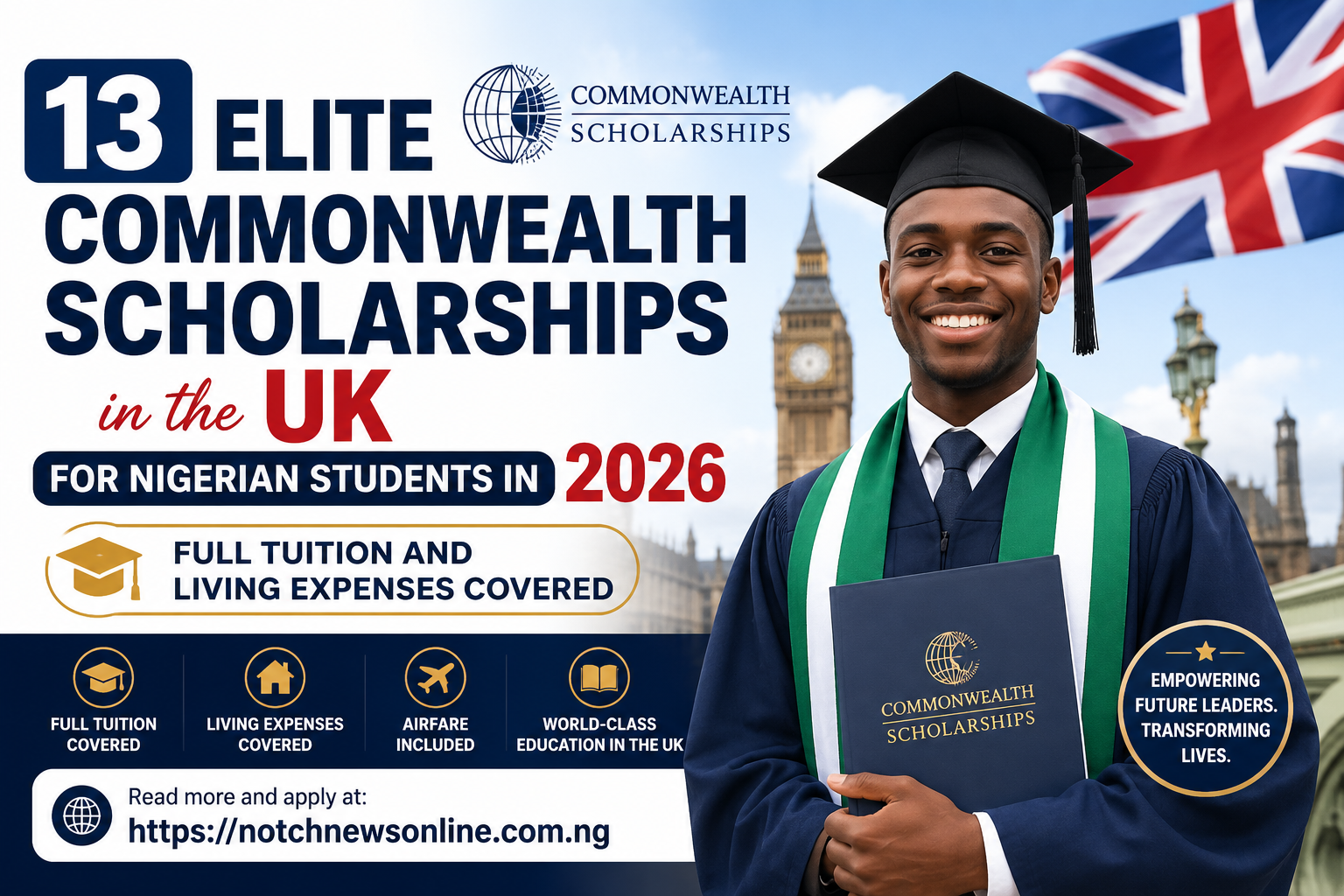
This is a genuinely fully funded award. Successful Nigerian scholars receive:
- Full payment of university tuition and examination fees.
- Return economy-class airfare between Nigeria and the UK.
- A monthly living allowance (stipend) to cover accommodation, food, and daily expenses — historically in the region of £1,400–£1,800 a month, with a higher rate for scholars based at universities in the London metropolitan area.
- A one-off arrival allowance to help with initial settling-in costs.
- A grant towards the cost of study-related travel, such as fieldwork.
- A warm-clothing allowance for scholars arriving from warmer climates, to help with the UK weather.
- For some categories, a thesis grant or research support grant.
There is no bond, no obligation to repay any part of the award, and no requirement to work for the UK government afterward. The only expectation is the spirit behind the whole programme: that you return to Nigeria (or another home country) and put your new qualification to use.
How Nigerians Actually Apply
This is the part that trips up many first-time applicants, because the Commonwealth Scholarship does not accept most applications directly. For the standard Master’s and PhD Scholarships, Nigeria operates a two-stage process.
Stage 1: The Federal Scholarship Board (FSB) Nomination
The Federal Ministry of Education, through the Federal Scholarship Board, is Nigeria’s official nominating agency for the Commonwealth Scholarship. When a new cycle opens, the FSB publishes a formal call for applications on its website and through education.gov.ng, and applicants complete the FSB’s own Electronic Application System (EAS) within a specified window. Candidates who pass this initial screening are typically invited to an in-person nomination interview held in Abuja. Only candidates nominated by the FSB at this stage move forward to the next step.
Stage 2: The CSC Central Application
Once nominated, candidates complete the Commonwealth Scholarship Commission’s own online application through its CSC Central portal, attaching supporting documents such as academic transcripts, degree certificates, a personal statement, a research or study proposal (for PhD and research-based awards), reference letters, and evidence of admission offers from UK universities. This is the application the Commission itself assesses to make the final award decision.
For Commonwealth Shared Scholarships, the route is different: applications go directly through the participating UK university rather than through the FSB, though your country of residence must still be on the eligible list, which Nigeria is.
Typical Documents You’ll Need
- A valid international passport.
- Your NYSC discharge or exemption certificate.
- Original and certified copies of academic transcripts and degree certificates.
- At least two letters of admission from UK universities (for most Master’s applications).
- Two academic or professional reference letters.
- A well-written personal statement outlining your goals and how the course serves Nigeria’s development.
- A research proposal, for PhD and research-based applicants.
- Proof of English language proficiency where required by your chosen university.
Typical Timeline
While exact dates shift slightly from year to year, the pattern has been fairly consistent. The FSB usually opens its national call in late August or early September, with a submission window of around four to six weeks. Interviews for shortlisted candidates typically follow in Abuja a few weeks after the FSB deadline closes. Nominated candidates then complete the CSC Central application, with final Commission decisions usually communicated in the first half of the following year, ahead of a September/October start date in the UK. QECS, by contrast, runs on its own separate schedule via the Association of Commonwealth Universities, usually opening in two windows across the year.
Because timing can shift, the safest approach is to bookmark the official pages, the Federal Ministry of Education’s education.gov.ng site and the Commonwealth Scholarship Commission’s own website, and check them from July onward each year so you are never caught off guard when a new cycle opens.
Tips for a Stronger Application
- Start early. Strong personal statements and research proposals take weeks to refine, not days.
- Secure your UK university admission offers well ahead of the FSB deadline; most Master’s routes require these before nomination.
- Be specific about development impact. Vague statements about “wanting to make a difference” are far weaker than a clear account of a problem in Nigeria and how your course addresses it.
- Choose referees who know your academic or professional work well, and give them enough notice to write a considered letter.
- Proofread every document. Selection committees see thousands of applications, and careless errors stand out for the wrong reasons.
- Apply to more than one scholarship where possible. Commonwealth is highly competitive, so pairing it with other options such as Chevening or university-specific awards spreads your chances.
Common Mistakes to Avoid
- Missing the FSB’s national deadline. The Commission does not accept direct applications from Nigerian citizens outside the nominating process for the main categories.
- Paying anyone for “guaranteed” scholarship placement. Application through the FSB and the CSC is entirely free.
- Submitting a generic personal statement that could apply to any country or any scholarship.
- Waiting until the deadline week to request transcripts or reference letters.
- Assuming a low undergraduate grade automatically disqualifies you from PhD categories, where a Second Class Lower Division is often accepted.
Final Thoughts
The Commonwealth Scholarship remains one of the most realistic pathways for Nigerian graduates to study in the UK without the crushing weight of international tuition fees and living costs. It is competitive, and the process, running through both the Federal Scholarship Board and the CSC’s own system, requires patience and careful preparation. But for candidates who plan ahead, secure strong admission offers, and can articulate a genuine link between their studies and Nigeria’s development, it remains an entirely achievable goal.
If studying in the UK is part of your plan, the best time to start preparing is now: research programmes, request your NYSC documentation early, and set a reminder to check the Federal Ministry of Education and Commonwealth Scholarship Commission websites as soon as the next cycle is likely to open.
Have you applied for the Commonwealth Scholarship before, or are you preparing your application now? Share your questions in the comments below.


 freeman4u16