 freeman4u16
Studying medicine is one of the most rewarding but expensive academic paths a Nigerian student can pursue. Between tuition, textbooks, clinical equipment, accommodation, and living expenses, the cost of a medical education can run into millions of naira, or tens of thousands of dollars if studying abroad. Fortunately, a growing number of scholarships, grants, and fellowships exist specifically to help Nigerian students achieve their dream of becoming doctors, nurses, pharmacists, and other healthcare professionals. This guide covers the major scholarship opportunities available, who is eligible, how to apply, and practical tips for building a winning application.
Why Medical Scholarships Matter
Nigeria faces a well-documented shortage of medical professionals, with many trained doctors emigrating in search of better pay and working conditions abroad, a trend often referred to as the “japa” syndrome. Scholarships play a critical role in reversing this trend by lowering the financial barrier to entry, allowing more talented students, particularly those from low-income households, to enter medical school in the first place. Beyond individual benefit, every scholarship awarded is an investment in Nigeria’s healthcare system, since scholarship recipients often go on to serve in underserved communities, teach the next generation of doctors, or lead public health initiatives.
Types of Medical Scholarships Available
Nigerian students interested in medicine can generally access four broad categories of funding:
- Government scholarships – Federal and state government-sponsored awards, including the Federal Government Scholarship Scheme and various state bursary programs.
- University and institutional scholarships – Merit or need-based awards offered directly by Nigerian universities or foreign institutions to attract strong applicants.
- International and foreign government scholarships – Fully or partially funded awards from countries such as the United States, United Kingdom, Canada, and China for students who wish to study medicine abroad.
- Private, corporate, and NGO scholarships – Awards funded by banks, oil companies, pharmaceutical firms, foundations, and professional medical associations.
Government Scholarships in Nigeria
1. Federal Government Scholarship Scheme (FGSS)
The Federal Ministry of Education runs an annual undergraduate scholarship scheme open to students in Nigerian universities, including those studying Medicine and Surgery. Awards are usually announced through the Federal Scholarship Board and require applicants to have strong WAEC/NECO results and a verified admission letter.
2. State Government Bursary and Scholarship Boards
Many states, including Lagos, Delta, Rivers, Kano, and Ondo, run their own scholarship boards that support indigenes studying medicine either locally or abroad. Eligibility is typically tied to state of origin, and students must present a local government identification letter along with academic transcripts. Amounts and application windows vary widely by state, so students should check their state ministry of education website or contact their local government scholarship desk directly each academic year.
3. Petroleum Technology Development Fund (PTDF)
Although PTDF is best known for engineering and technology scholarships, it periodically opens overseas postgraduate scholarship windows that medical graduates in public health, biomedical sciences, or health-related research can apply for, particularly at the master’s and PhD levels.
University-Specific Scholarships
Several Nigerian universities offer internal scholarships to outstanding medical students, usually based on the results of the first professional examination (100-level to 200-level transition) or overall CGPA. Examples include:
- University of Ibadan Vice-Chancellor’s Prize for academic excellence in the College of Medicine.
- University of Lagos College of Medicine merit scholarships for top-performing students in pre-clinical years.
- Obafemi Awolowo University endowment-funded prizes for outstanding performance in anatomy, physiology, and biochemistry.
- Private Nigerian universities such as Babcock University and Bowen University, which offer needs-based tuition waivers and merit scholarships to medical students with strong WAEC and post-UTME scores.
Because these awards are managed internally, the best approach is to check directly with the college of medicine’s student affairs office or scholarship unit once admission has been secured, since many of these opportunities are not widely advertised.
International Scholarships for Studying Medicine Abroad
1. Commonwealth Scholarships (UK)
The Commonwealth Scholarship and Fellowship Plan funds Nigerian students for master’s and PhD study in the United Kingdom, including in public health, medical research, and allied health fields. Undergraduate medical degrees are not covered, but the scheme is a strong option for Nigerian doctors seeking postgraduate specialization.
2. Chevening Scholarships (UK)
Chevening funds one-year master’s programs in the UK across all disciplines, including global health, health policy, and biomedical sciences. It is highly competitive and requires at least two years of work experience, making it more suitable for practicing Nigerian doctors than fresh undergraduates.
3. Fulbright Foreign Student Program (USA)
The Fulbright program supports Nigerian graduate students pursuing master’s or PhD study in the United States, including in public health and biomedical research, though not typically for the MD degree itself due to US medical school funding structures.
4. Chinese Government Scholarship (CSC)
China has become an increasingly popular destination for Nigerian students pursuing MBBS (Bachelor of Medicine, Bachelor of Surgery) degrees. The China Scholarship Council, in partnership with individual Chinese universities, offers full and partial scholarships covering tuition, accommodation, and a monthly stipend for international students, including those in medical programs taught in English.
5. MBBS Scholarships in Ukraine, Russia, and India
Prior to recent regional instability, Ukraine and Russia were popular low-cost destinations for Nigerian MBBS students, with some universities offering partial tuition discounts. India also remains a widely chosen destination, with several private medical colleges offering merit-based fee reductions for high-scoring international applicants. Students considering these routes should verify current safety conditions, accreditation status, and Medical and Dental Council of Nigeria (MDCN) recognition of the degree before enrolling.
Private and Corporate Scholarships
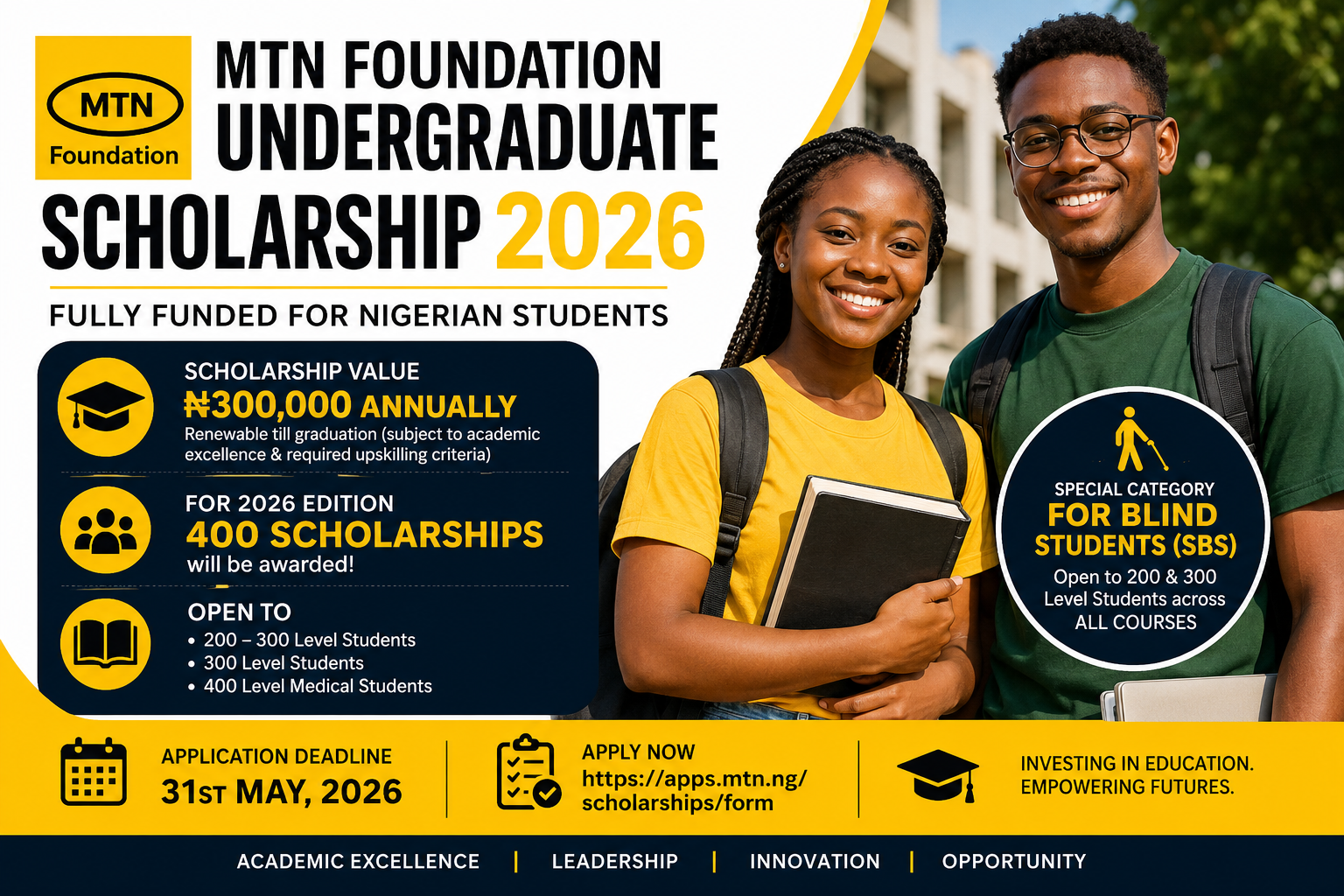
- MTN Foundation Scholarship Scheme – supports Nigerian undergraduates in various fields, including medicine, based on academic merit and financial need.
- NNPC/Total National Merit Scholarship – open to Nigerian undergraduates, including medical students, based on strong academic performance.
- Nigerian Breweries Plc, Access Bank, and GTBank scholarship schemes – periodically include health science students in their beneficiary lists.
- Rotary Club and Lions Club scholarships – smaller, community-based bursaries that support indigent students in health-related courses.
These corporate scholarships are usually advertised through national newspapers, company websites, and social media, so following the corporate social responsibility (CSR) pages of major Nigerian companies is a practical way to stay informed.
Eligibility Requirements Common Across Most Scholarships
While each scholarship has its own specific criteria, most medical scholarships in Nigeria share the following general requirements:
- A minimum grade average, often a CGPA of 3.5/5.0 or above, or equivalent WAEC/NECO distinctions in core science subjects.
- Proof of admission or enrollment in an accredited medical program, whether in Nigeria or abroad.
- A letter of recommendation from a lecturer, school principal, or academic advisor.
- A well-written personal statement or motivation essay explaining career goals and financial need.
- Nigerian citizenship or state of origin documentation, particularly for government-funded awards.
- For need-based awards, evidence of financial hardship such as a sworn affidavit or local government attestation of income status.
How to Apply: A Practical Step-by-Step Approach
1. Start early. Many scholarship application windows open months before the academic year begins and can close within weeks. Set calendar reminders for recurring scholarships like the Federal Government Scholarship Scheme, which tends to open annually around similar periods.
2. Organize your documents in advance. Keep digital copies of your WAEC/NECO results, admission letter, birth certificate, local government identification, and passport photographs ready so you are not scrambling when a scholarship opens.
3. Tailor your personal statement. Avoid generic essays. Explain specifically why you want to study medicine, any relevant experiences (volunteering, family background in healthcare, community health challenges you have witnessed), and how the scholarship will help you achieve your goals.
4. Request recommendation letters early. Give your referees at least two to three weeks’ notice, and provide them with your CV and a summary of the scholarship to help them write a strong, specific letter.
5. Apply broadly, not just for one award. Because competition is high, apply to multiple scholarships in parallel rather than waiting on a single outcome.
6. Verify legitimacy before applying. Unfortunately, scholarship scams targeting Nigerian students are common. Always confirm that a scholarship is being advertised through the official website of the government body, university, or company involved, and never pay an “application processing fee” to receive a scholarship, since legitimate scholarships do not charge students to apply.
Common Mistakes to Avoid
- Missing deadlines because of incomplete documentation.
- Submitting a personal statement that reads like a template rather than a genuine reflection of the applicant’s story.
- Ignoring smaller, less competitive local scholarships in favor of only pursuing high-profile international awards.
- Failing to confirm that a foreign medical degree will be recognized by the Medical and Dental Council of Nigeria (MDCN) before committing to a program abroad.
- Not following up on application status or failing to respond promptly if selected for an interview.
Where to Find Updated Scholarship Listings
Because scholarship programs open and close throughout the year, and new opportunities are introduced regularly, students should make a habit of checking the following sources on a monthly basis:
- The Federal Ministry of Education and Federal Scholarship Board websites.
- Individual state ministry of education portals.
- The official websites of target universities, both Nigerian and international.
- Reputable Nigerian education and scholarship information platforms and newsletters.
- The British Council, US Embassy Nigeria, and Chinese Embassy education and cultural affairs pages for country-specific scholarship announcements.
Frequently Asked Questions
Can I get a scholarship if I am already in 300 or 400 level?
Yes. While some scholarships target incoming first-year students, many, including state bursaries and corporate awards, are open to students at any stage of the medical program, provided academic performance remains strong. It is worth applying every year rather than assuming eligibility is limited to freshers.
Do I need a JAMB score above a certain cut-off to qualify?
Most scholarship bodies do not set a fixed JAMB cut-off beyond the standard admission requirement for medicine, which is typically high. What matters more for scholarship purposes is sustained academic performance once enrolled, since GPA or sessional results are usually the deciding factor.
Are there scholarships specifically for female medical students?
Yes. Several organizations and foundations run programs aimed at increasing the number of women in medicine and STEM fields more broadly. These are often listed alongside general scholarships on university and NGO websites, so female applicants should search specifically using terms like “women in STEM” or “female medical scholarship Nigeria” when researching opportunities.
Is it better to study medicine in Nigeria or abroad if I want a scholarship?
This depends on individual circumstances. Studying in Nigeria is generally more affordable even without a scholarship, and local scholarships tend to be less competitive than international ones. Studying abroad can offer access to better facilities and, in some cases, fully funded programs, but it also comes with higher living costs, visa requirements, and the added step of ensuring MDCN recognizes the degree afterward. Weigh both routes carefully before committing.
What should I do if I cannot afford application or travel costs for an international scholarship?
Some scholarships, particularly government-to-government schemes, cover application and travel costs once selected. Where this is not the case, reach out to local NGOs, place of worship community funds, or alumni associations of your intended university, as many offer small grants specifically to help cover these preliminary costs for promising candidates.
Final Thoughts
A career in medicine is one of the most impactful paths a young Nigerian can take, both for personal fulfillment and for the country’s healthcare future. While the financial barriers can feel overwhelming, the scholarships outlined in this guide show that funding is available at nearly every level, from state government bursaries to fully funded international awards. The key is persistence: start early, apply widely, keep your documents organized, and never let a single rejection discourage you from applying to the next opportunity. With the right preparation, a Nigerian student determined to study medicine can find a path that makes that dream financially achievable.
Disclaimer: Scholarship names, amounts, and eligibility criteria referenced in this article are subject to change. Readers should always verify current details directly on the official website of the relevant institution before applying.


 freeman4u16